

Gold vs. Inflation: A Historical Look at Wealth Preservation
On the quiet Sunday evening of August 15, 1971, President Richard Nixon appeared on national television to deliver a speech that would fundamentally alter the global economy. In what became known as the “Nixon Shock,” he announced the unilateral cancellation of the direct international convertibility of the U.S. dollar to gold. For the average American, it was an abstract policy shift. For the world’s financial architecture, it was a seismic event. This decision to “close the gold window” ended the Bretton Woods system that had governed international finance since World War II and, in doing so, launched a real-world experiment on the value of fiat currency versus hard assets. The decade that followed would become one of history’s most compelling case studies on gold’s enduring power to preserve wealth.The Historical Context: A System Under Strain
To understand the chaos of the 1970s, one must first appreciate the stability that preceded it. The Bretton Woods agreement, established in 1944, pegged the U.S. dollar to gold at a fixed rate of $35 per ounce. Other major world currencies were then pegged to the U.S. dollar, making it the global reserve currency. This system provided a predictable and stable framework for international trade and finance for over two decades. The U.S. held the majority of the world’s gold reserves and its economic might was unparalleled. By the late 1960s, however, significant cracks had begun to form in this golden foundation. The U.S. government was running massive budget deficits, driven by the dual costs of the Vietnam War and President Lyndon B. Johnson’s ambitious “Great Society” domestic spending programs. To finance these expenditures, the Federal Reserve expanded the money supply. More and more dollars were being printed and circulated globally, but the U.S. gold reserves were not growing in tandem. Other countries, particularly France, grew wary of the increasing number of dollars relative to the gold backing them and began to aggressively redeem their dollar holdings for U.S. gold, as was their right under the Bretton Woods system. The gold reserves at Fort Knox were steadily draining away, creating a crisis of confidence in the dollar’s peg.What Happened: The Perfect Economic Storm
Nixon’s 1971 decision was not a proactive strategy but a defensive maneuver to halt the outflow of American gold and protect the nation’s dwindling reserves. By severing the dollar’s last link to gold, the world’s currencies were set adrift, ushering in the modern era of floating exchange rates and purely fiat money—currency backed not by a physical commodity, but by government decree and public trust. This monetary upheaval was soon compounded by a severe geopolitical crisis. In October 1973, the Organization of Arab Petroleum Exporting Countries (OPEC) launched an oil embargo against the United States and other nations that had supported Israel during the Yom Kippur War. The price of crude oil, the lifeblood of industrial economies, quadrupled almost overnight from around $3 to $12 per barrel. The shock was immediate and devastating. The cost of everything—from the gasoline in a car’s tank to the production of goods and the transport of food—skyrocketed. The U.S. economy was plunged into a toxic spiral that economists dubbed “stagflation”: a rare and painful combination of economic stagnation (rising unemployment and slow growth) and high inflation. The 1970s became a decade defined by economic malaise. Americans faced long lines at gas stations, businesses struggled with soaring costs, and the value of paychecks and savings seemed to shrink with each passing month. The economic optimism of the post-war era gave way to a pervasive sense of anxiety and decline.During the stagflation of the 1970s, as the U.S. dollar lost more than half its purchasing power, the price of gold appreciated by over 2,300%—a historic transfer of wealth into a proven store of value.
The Immediate Impact: A Tale of Two Assets
The data from this period paints a stark picture of the diverging fates of fiat currency and gold. As the government’s promises faltered, the ancient monetary metal thrived.- Rampant Inflation: The Consumer Price Index (CPI), the government’s primary gauge of inflation, told a frightening story. After averaging 2-3% in the early 1960s, it surged to 6.2% in 1973, then a shocking 11.1% in 1974. After a brief moderation, it soared again, peaking at an eye-watering 13.5% in 1980.
- The Dollar’s Collapse: For savers holding cash, the decade was a disaster. The relentless inflation decimated the dollar’s purchasing power. According to the Bureau of Labor Statistics’ own data, a dollar from January 1970 was worth only 45 cents by January 1980. Holding dollars was a guaranteed way to lose wealth.
- A “Lost Decade” for Stocks: The stock market, often seen as a hedge against moderate inflation, failed to provide a safe harbor. The S&P 500 Index lost nearly 50% of its value in real, inflation-adjusted terms between 1973 and 1974. For the decade as a whole, the market’s performance was essentially flat, earning it the moniker of the “lost decade” for equity investors.
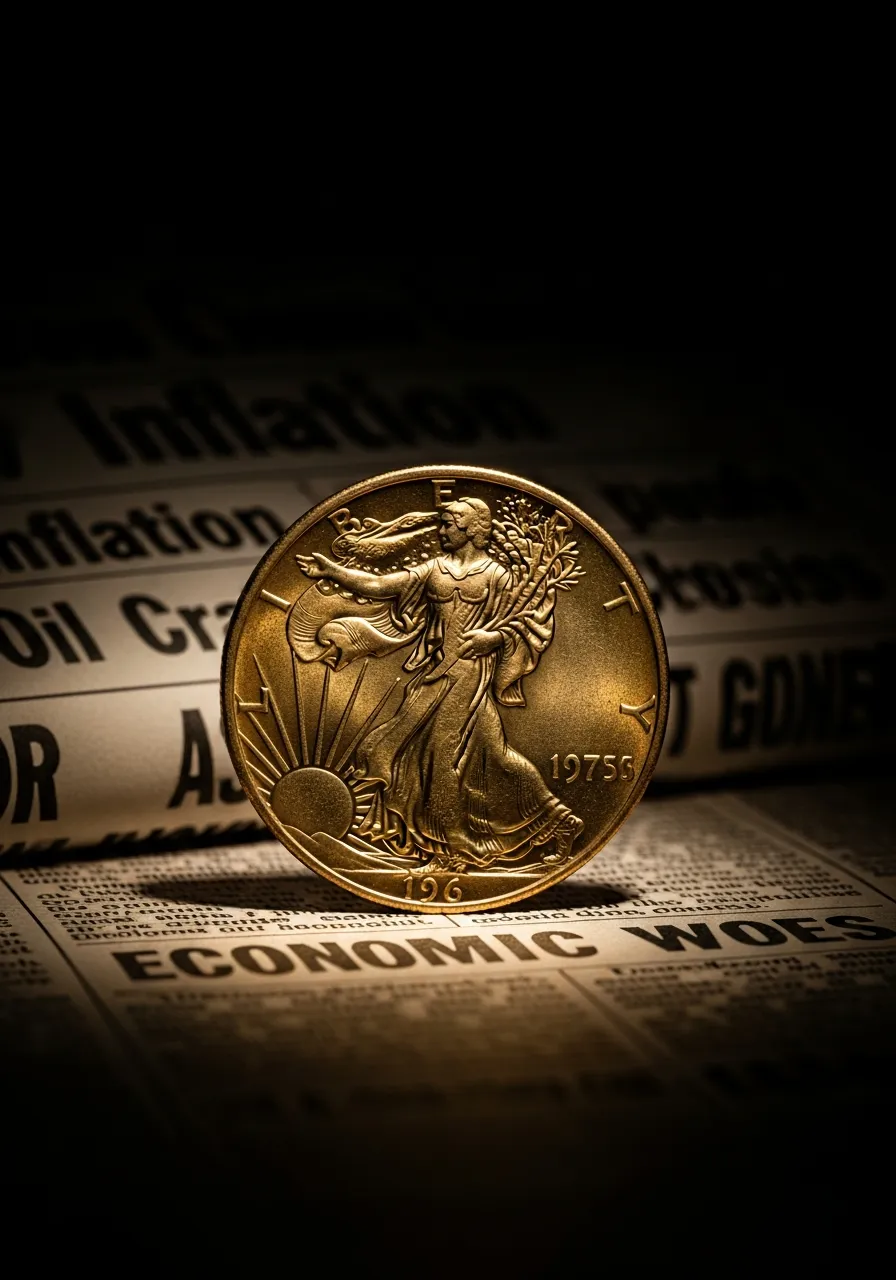
- Gold’s Historic Ascent: Freed from its $35 leash, gold did precisely what historical precedent suggested it would. It acted as a monetary barometer, rising as faith in paper currency fell. The price climbed from $35/ounce in August 1971 to nearly $200 by the end of 1974. As the second wave of inflation took hold in the late 1970s, the flight to gold became a stampede. The price famously screamed past $850 per ounce in January 1980—an astonishing gain of more than 2,300% from its starting point.
Long-Term Consequences: A New Monetary Order
The “Great Inflation” of the 1970s left an indelible mark on the global economy and investor psychology. Its primary consequence was the formal death of the gold standard and the universal adoption of the fiat currency system we live with today. Currencies are no longer anchored to a tangible asset but float against one another, their value a reflection of economic strength, central bank policy, and market sentiment. The crisis also forced a dramatic shift in central banking. To finally slay the inflationary dragon, Federal Reserve Chairman Paul Volcker took the radical and politically painful step of raising the federal funds rate to a peak of 20% in 1981. This aggressive tightening of the money supply plunged the economy into a deep recession but successfully broke the back of inflation. It was a stark demonstration of the extreme measures required to restore confidence in a fiat currency once it has been lost. Most importantly for savers, the 1970s cemented gold’s modern role. It was no longer just a relic of a bygone monetary system. It had proven itself to be a non-correlated asset that shines brightest when traditional financial assets—and the currencies they are priced in—are under duress. For generations of investors, the stagflation era became the definitive textbook example of why a diversified portfolio must include an allocation to gold for long-term wealth preservation.Lessons for Today: The Echoes of History
Examining the 1970s is more than an academic exercise; it offers a pragmatic blueprint for navigating today’s economic environment. The parallels between then and now are compelling and should command the attention of anyone serious about protecting their purchasing power.Parallel 1: Unprecedented Money Creation
Just as the spending of the 1960s set the stage for the inflation of the 1970s, the monetary and fiscal policies of the 21st century have created similar preconditions. In response to the 2008 Global Financial Crisis and the 2020 COVID-19 pandemic, central banks and governments unleashed trillions of dollars in stimulus and quantitative easing. The U.S. M2 money supply—a broad measure of money in circulation—expanded at a rate unseen in modern history. This dramatic increase in the supply of currency, without a corresponding increase in goods and services, is the classic recipe for inflation.Parallel 2: Geopolitical and Supply Shocks
Today’s world is rife with the kind of supply shocks that defined the 1970s. The OPEC embargo finds its modern echoes in pandemic-induced supply chain disruptions, geopolitical conflicts affecting global energy and food supplies, and a growing trend of de-globalization. These factors constrain the supply of essential goods, pushing prices higher and contributing to inflationary pressures that are difficult for central banks to control.The Unchanged Principle: The Flight to Tangible Value
When people witness the cost of living rising faster than their wages and savings, their trust in the long-term stability of their currency inevitably erodes. This is not a complex financial theory; it is human nature. They begin to seek refuge in assets that are finite, tangible, and cannot be devalued by a printing press. This is the fundamental, time-tested driver of demand for gold. The core lesson from the 1970s is that in an economic regime characterized by high inflation and eroding trust, capital flows away from paper promises and toward hard assets. Gold, with its 5,000-year history as a store of value, is the primary beneficiary of this shift. While physical gold provides a tangible store of value, modern advancements offer new ways to own it. For instance, understanding how digital gold tokenization secures your investment reveals how technology is making this ancient asset more accessible and liquid for today’s savers. The ultimate takeaway is not that one should abandon traditional investments, but that a portfolio without a meaningful allocation to a proven inflation hedge is dangerously exposed to the very risks that defined the 1970s.History does not repeat itself, Mark Twain is often quoted as saying, but it often rhymes. The stagflation of the 1970s offered a painful, unforgettable lesson on the fragility of fiat currency and the enduring strength of gold. The economic verses being written today contain familiar rhymes of currency debasement, geopolitical strife, and rising inflation. The critical question for every forward-thinking saver is whether their financial strategy is prepared for the echoes of the past.
